Sunday, May 10, 2015

FICTION: Thus bad begins (Así empieza lo malo) a novel by Javier Marías
"Así empieza lo malo" (Thus bad begins) is
the latest novel of Spanish writer Javier Marías. It was published in Spain on
23 September 2014 and will, most likely, be released in English in 2015.
Marías' novels have been published in 50 countries and translated into 40
languages. He is considered one of the best contemporary European writers; in
the last few years his name has been in the shortlist of candidates for the
Nobel Prize of Literature.

The title of the novel "Así empieza lo malo" (Thus bad begins) comes from Hamlet. Marías knows Shakespeare's work very well and has used his verses as titles for some of his novels. 'Thus bad begins' is the first half of a verse line from Act 3, scene 4 of Hamlet: 'Thus bad begins and worse remains behind' (Así empieza lo malo y lo peor queda atrás).
Other novels by Marías with verses from Shakespeare are: 'A Heart so White' (1992) from Macbeth, 'Tomorrow in the Battle Think on Me'(1994) from Richard III, and 'Your Face Tomorrow' (2002, 2004, 2007) from Henry IV whose 1600 pages were published in separate 3 volumes.
Marías recognises Shakespeare's influence in his work: 'In my case, the presence of Shakespeare (in my books) is almost connatural'. And, as a source of inspiration "...someone like Shakespeare leaves many paths unexplored, many things just announced, strong images unexplained—all this invites you not to follow him but to be inspired. Shakespeare inspires me." (Paris Review. N. 190).
'Thus bad begins' is set in Madrid in the 1980's. Juan de Vere, the narrator, now a middle-aged man, remembers his first job as a personal assistant to Eduardo Muriel, a cinema director. The story is told from the present time and the central plot develops around the unhappy marriage of Eduardo Muriel and Beatriz Noguera. Curiously, as it happened in his previous novel 'Los Enamoramientos' (The Infatuations) someone is spying on the private life of a married couple: in that novel, it was a woman, and in this one it is Juan de Vere himself.
The 1980's was the decade that saw democracy reinstated in Spain after the years of Franco's dictatorship. Franco had ruled the country unopposed, for almost 40 years, until his death in 1975, so when he died, the country was ready for change. The Spanish Constitution of 1978 transformed Spain into a Constitutional Monarchy, and the Amnesty Law passed in 1977, absolved the regime & its acolytes of any responsibility for crimes committed during the years 1936-1977.
So, for some people, there was nothing to fear, and changing sides, that is, moving from being a Franco supporter to a democrat, was not only possible but a straightforward & safe process. The euphemism of the time "changing jackets" (cambiar de chaqueta) conveyed this idea well. Some people, before mutating into instant democrats, did some nip and tuck to their biographies, hiding all that would not be considered appropriate in the newly born democracy; and so, you had some people who, with their faces freshly washed and a new jacket, could carry on with their privileged lives as if they were entitled to it by Divine Law.
I do not want to go into much detail about the plot of this novel but this is how Javier Marías summarized the book when it was released in Spain last year: “It is about the impunity and the arbitrarily of forgiveness, it is about how we can forgive some serious events while, at the same time, are not willing to forgive small misdeeds; it is about how we can't overlook small matters; it is about sexual desire and obstinacy in love, it's about desire as the engine that moves a person into action and how this can be done in a noble or an ignoble way."
© Imma Hilly, May 2015
Friday, May 1, 2015
SPANISH CINEMA - CARMINA Y AMÉN (Carmina & Amen) Spain (2014)
SPANISH FILM FESTIVAL IN AUSTRALIA 2015

'Carmina y Amén' is the sequel of 'Carmina y revienta' (Carmina & Blow Up) a film that in 2012 took the Spanish cinema scene by surprise. With a very limited budget, Paco León, an actor from Seville, decided to make 'Carmina y Revienta' with his mother (Carmina Barrios) as Carmina, and his sister (Maria León) as María, Carmina's daughter. It was, clearly, a family affair; so much that they didn't even bother to change the character's names. The film, however, is far from being a biopic of the Barrios-León family; it is rather, a successful cinematographic experiment that Paco León had had in mind for quite some time.
Carmina, the character, was a 57 in the first movie, she lived in Seville and was running a family bar with her husband. The movie starts in Carmina's kitchen. In the small hours of the night she is alone smoking a cigarette and muttering what to do. There have been a series of robberies in the family bar they run and the insurance company is not cooperating. From here onwards we become interested in her story and we wish she succeeds in solving her problem despite her methods, often far from orthodox.
The film is not a morality tale but one of survival. Carmina Barrios, the actress, has given life to a fantastic Carmina, a woman who is a fighter in the best sense of the word; believing in fatalism, a life set of beliefs that have served so well the Mediterranean people across the ages. His son has recognised that her mother brought to the character much more than he had in mind and could see the Carmina saga expanding, not necessarily as Carmina. We will have to wait and see what he meant.
SOME BACKGROUND
THE PLOT
Unfortunately for non-native speakers, the Andalusian speech is hard to understand as Andalusians speak fast and break words in half, so 'para' becomes 'pa', 'nada' becomes 'ná' and so on. Students of Spanish should not be discouraged, this is no Salamanca Spanish, but the language is alive, rich, colourful, full of life, very much like their people. This is the land of my father, so I know what I am talking about.
The following are some notes before seeing the movie.
'Carmina y Amén' is the sequel of 'Carmina y revienta' (Carmina & Blow Up) a film that in 2012 took the Spanish cinema scene by surprise. With a very limited budget, Paco León, an actor from Seville, decided to make 'Carmina y Revienta' with his mother (Carmina Barrios) as Carmina, and his sister (Maria León) as María, Carmina's daughter. It was, clearly, a family affair; so much that they didn't even bother to change the character's names. The film, however, is far from being a biopic of the Barrios-León family; it is rather, a successful cinematographic experiment that Paco León had had in mind for quite some time.
Carmina, the character, was a 57 in the first movie, she lived in Seville and was running a family bar with her husband. The movie starts in Carmina's kitchen. In the small hours of the night she is alone smoking a cigarette and muttering what to do. There have been a series of robberies in the family bar they run and the insurance company is not cooperating. From here onwards we become interested in her story and we wish she succeeds in solving her problem despite her methods, often far from orthodox.
The film is not a morality tale but one of survival. Carmina Barrios, the actress, has given life to a fantastic Carmina, a woman who is a fighter in the best sense of the word; believing in fatalism, a life set of beliefs that have served so well the Mediterranean people across the ages. His son has recognised that her mother brought to the character much more than he had in mind and could see the Carmina saga expanding, not necessarily as Carmina. We will have to wait and see what he meant.
SOME BACKGROUND
It has been said
of Andalusia that it is a matriarchy. May be. This is not the post to discuss
this but Carmina, and she certainly is a matriarch, an Andalusian matriarch.
She reminds me of another matriarch, Janine Codi, an Australian from Melbourne,
that the wonderful Jacki Weaver created in 'Animal Kingdom'. These two
women however are very different; Janine Codi was a sociopath, cold, cunning,
calculating and manipulative; Carmina on the other hand is fatalistic, pragmatic,
a 'what you see is what you get' and 'this is what there is and if you don't
like it, stiff bikkies' kind of woman; but she is also wise. She listens to
people's problems and only acts if the believes it is necessary. These
two women are strong and determined, and they know how to get ahead in life,
even when life is not how they would like it to be.
THE PLOT
In the first
movie, in one of Carmina's monologues in her kitchen at night there is a scene
where she looks directly into the camera and tells exactly what will happen in
this sequel, which is the following: the sudden death of Carmina's husband. The
problem is that he dies two days before his pay is due to arrive. Carmina will
convince her daughter to keep her husband’s death a secret for two days, until
that much needed payment arrives.
Unfortunately for non-native speakers, the Andalusian speech is hard to understand as Andalusians speak fast and break words in half, so 'para' becomes 'pa', 'nada' becomes 'ná' and so on. Students of Spanish should not be discouraged, this is no Salamanca Spanish, but the language is alive, rich, colourful, full of life, very much like their people. This is the land of my father, so I know what I am talking about.
Saturday, April 18, 2015
SHORT STORY: Eduardo Galeano: un mar de fueguitos / a sea of little fires
Eduardo Galeano: in memoriam.
(Montevideo: 3 septiembre 1940 – 13 abril 2015)
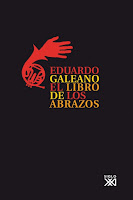
De 'El Libro de los Abrazos: El mundo (ver texto en castellano abajo)
From 'The Book of Embraces: The world (See English text below)
Eduardo Galeano reads in Spanish: Un mar de fueguitos
EL MUNDO
 “Un hombre del pueblo de Neguá, en la costa de Colombia, pudo subir
al cielo. A la vuelta, contó. Dijo que había contemplado, desde allá
arriba, la vida humana. Y dijo que somos un mar de fueguitos.
– El mundo es eso – reveló –. un montón de gente, un mar de fueguitos. No hay dos fuegos iguales. Cada persona brilla con la luz propia entre todas las demás. Hay gente de fuegos grandes y fuegos chicos y fuegos de todos los colores. Hay gente de fuego sereno, que ni se entera del viento, y hay gente de fuego loco, que llena el aire de chispas; algunos fuegos, fuegos bobos, no alumbran ni queman, pero otros arden la vida con tantas ganas que no se puede mirarlos sin parpadear, y quien se acerca se enciende. (...)”
THE WORLD
 A man of the town of Neguá, on the coast of Colombia, was able to climb to the high heaven.
On his return, he told a story. He said he had contemplated, from above, human
life. And said that we are a sea of little fires. The world is that—he revealed—A
cluster of people, a sea of little fires. Each person shines with their own
light among all others. No two fires are alike. There are large fires and small
fires and fires of all kinds and colors. There are people of serene fire,
unaware of the existence of wind, and people of crazy fire, who fill the air
with sparks. Some fires, foolish fires, do not shine or burn; but others burn
life so heartily you cannot observe them without stopping to blink, and whoever
gets close, flares up.
(Montevideo: 3 septiembre 1940 – 13 abril 2015)

De 'El Libro de los Abrazos: El mundo (ver texto en castellano abajo)
From 'The Book of Embraces: The world (See English text below)
Eduardo Galeano reads in Spanish: Un mar de fueguitos
EL MUNDO
“Un hombre del pueblo de Neguá, en la costa de Colombia, pudo subir
al cielo. A la vuelta, contó. Dijo que había contemplado, desde allá
arriba, la vida humana. Y dijo que somos un mar de fueguitos.– El mundo es eso – reveló –. un montón de gente, un mar de fueguitos. No hay dos fuegos iguales. Cada persona brilla con la luz propia entre todas las demás. Hay gente de fuegos grandes y fuegos chicos y fuegos de todos los colores. Hay gente de fuego sereno, que ni se entera del viento, y hay gente de fuego loco, que llena el aire de chispas; algunos fuegos, fuegos bobos, no alumbran ni queman, pero otros arden la vida con tantas ganas que no se puede mirarlos sin parpadear, y quien se acerca se enciende. (...)”
THE WORLD
Saturday, July 26, 2014
LANGUAGE MATTERS: I want to learn Spanish because ...

When I start a new class the first thing I do is to ask my new students ... 'Why do you want to learn Spanish?'
Over the years I have been given a great number of answers, ranging form the very serious to the very trivial. Any reason, however, is a valid reason to me, who would struggle to give a reason of why I love languages so much. I just do.
So, here is a sample of valid reasons:
- I want to travel to Latin America.
- I want to travel to Spain.
- I am travelling to Latin America / Spain soon.
- I want to do el Camino del Inca. (The Inca Trail)
- I want to do el Camino de Santiago.
- My boyfriend or girlfriend is a (native) Spanish-speaker.
- My daughter or son is marrying a Mexican (or a Peruvian ... or Argentinian ...)
- I love the sound of the language. I'd love to speak it.
- I have always wanted to learn a second language.
- I've just come back from a holiday in Europe and I was so embarrassed, everybody seemed to be at least bi-lingual over there...
- It's a language that seems easy.
- I'd like to read in Spanish.
- I am bored.
- I studied the language many years ago. I now have the time to continue learning it.
- If you speak English and Spanish you can travel the world.
- I'd like to read Lorca or Neruda ...
- I want to get my brain working.
- I think I was a Spanish gypsy in a previous life.
- I'd love to be bi-lingual.
- I want to do something different, something new.
- I watch films in Spanish on SBS and I would like to understand what they say.
- My grandfather was Spanish.
- I dance flamenco and I want to go to Sevilla to do a course.
- I want to teach English in Latin America.
- I love Spanish art.
- I want to do a cooking course in Spain.
- I am in love with Penelope Cruz.
- I do business in Uruguay
- I do business in Chile
- I am going to Buenos Aires to learn to dance the tango.
- I want to see Game of Thrones in Spanish
It is a splendid list as far as intentions is concerned. The hardest part is, of course, to start learning and not giving up at class number three, when one realises that this pursuing with this activity will require commitment, perseverance, passion and (these days) it costs a lot of money as well.
Thursday, July 24, 2014


Thursday, May 8, 2014
SPANISH IDIOMS: Estar en las nubes > to have one's head in the clouds

Idiomatic
expressions enrich and colour languages.
Here are
some expressions using NUBE (cloud) with examples in English & Spanish:
·
ESTAR EN LAS NUBES (to have one's head in the clouds)
o Pepe no escucha, siempre está en las nubes.
o Pepe never listens, his head is always in the clouds.
·
ANDAR POR LAS NUBES (to have one's head in the clouds)
o No te escucha, anda por las nubes.
o He/she is not listening, his/her head is in the clouds.
·
VIVIR EN LAS NUBES (to live in the clouds)
o Ana vive en las nubes, nunca se entera de nada
o Ana lives in the clouds, she
never knows what's going on
·
ESTAR EN UNA NUBE (to be on cloud nine)
o Míralos, están en una nube.
o Look at them, they are on cloud
nine.
·
BAJAR A ALGUIEN DE SU NUBE (to take someone down a peg)
o El jefe lo ha bajado de su nube.
o The boss has taken him down a
peg.
Subscribe to:
Posts (Atom)