Wednesday, March 25, 2026

Galicismos comunes del español

¿A qué llamamos 'galicismo'?

Un galicismo es una palabra o expresión que proviene de la lengua francesa que ha sido incorporada a la lengua española.

Se estima que existen más de 6.000 galicismos en español, los cuales han sido asimilados a la lengua española a lo largo de los siglos, especialmente desde el siglo XVIII hasta la actualidad.


Tuesday, March 12, 2019

"We promise not to laugh at your Spanish"

A modern fable for adult learners of a foreign language.


Bar la Boca del León in Plaza Altozano, Sevilla


“You almost kill yourself (figuratively speaking) studying Spanish for 4 years. Then, one day, you decide it's time to put your efforts to the test and decide to travel to Seville, stay there for a fortnight and practice your Spanish ‘face-to-face’ with ‘the locals’ (“los nativos” as they are called over there).

The cost of the trip almost gets you bankrupt but you don’t care because ‘we only live once’.

You arrive in Seville and immediately love the place. You go directly to your ‘pensión’ and leave your suitcase there. You should have a rest but you can’t.  How can you delay the visit to ‘the Bar’ in the ‘Oh-so-mythical-Barrio-of-Triana’ that is highly recommended in your Lonely Planet guide? No, you can't. You freshen up and leave straight away. It's almost midday. It's not too far so you decide to walk. 

When you arrive at ‘the Bar’ you are welcomed by a waiter who wants to take your order and when you are just about to utter your first sentence in Spanish, (which was going to be “¿tienen albóndigas? (do you have meat balls?), you see a sign written in Spanish that says: “WE PROMISE NOT TO LAUGH AT YOUR SPANISH”.

You re-read it. “WE PROMISE NOT TO LAUGH AT YOUR SPANISH” You re-read quickly several times “WE PROMISE NOT TO LAUGH AT YOUR SPANISH”. Yes, this is clearly what it says. Your brain shifts into overdrive and in your mind’s eye you picture yourself being laughed at by the whole bar, about 30 people.

The fact that in the sign it also states clearly that “OUR ENGLISH IS NOT VERY GOOD” (meaning: “is pretty bad and possibly unintelligible”) makes no difference to you. You were not expecting this. You did not prepare for this. You could, certainly, engage in a two-way activity: ‘I laugh at your bad English and you laugh at my bad Spanish’ but you are not having none of this because you are not the type of person who has fun at other peoples’ expense.

The waiter is waiting and still talking to you, but you are not listening. You are so offended that can’t think at all. You stand up, thank him, in English, and leave the bar. 

While you are walking back to the ‘pensión’ sobbing quietly, you hear the voices of you mother and your grand-mother, both good Methodists and highly pragmatic ladies saying to you: chin up girl, chin up and wipe out these tears, it is not that bad.

When you arrive at the pension you think the place looks ‘shady'. You go straight up to your room, your dark and smelly room you realise now, grab your unpacked suitcase, go back downstairs, check yourself out and get out of the place as fast as lightning.  Shortly after, inside a taxi, you tell the driver, in a perfectly pitched Oxford accent, ‘To the airport, please’.

You will go back home as quickly as possible and forget about learning any f*ck*ng foreign language for the rest of your life, that is, forever and ever, or, if you know any Latin: for ‘seacula saeculorum’.

Who told you that in a global world people need to speak languages?  This is not a global world, this is a rude world.  Being insulted like that, after all these years of study, and in Seville, of all places.

From now on it will be ‘English only’ and for a hobby learning to play the flute or do some bird watching do not seem such a bad idea.

THE END


The silly story is not real, obviously, but the sign shown in the photo is. It's form the bar 'la Boca del León' in Plaza Altozano, Sevilla). I have written this because as a foreign language teacher of adults of many years, I like to help students who struggle to overcome the fear of failure and the fear of being ridiculed. With languages you can make mistakes "all-the-time"so you need some perspective regarding your linguistic performance. 

If I had to assign a moral of this modern fable would be: "Do not make a mountain out of a molehill."

Learning a language involves at some stage ‘to go solo’ that is, getting out of the comfort zone that is the classroom, your class mates, the computer, or whatever applications you have used to learn and study the language. The time comes when you have to jump into the void, so to speak, and this can feel awful but it should not be.

Learning a language gives a learner, not only the satisfaction of communicating in another language, but also a sense of personal achievement, the satisfaction of having overcome many barriers including the fear of being ridiculed, criticised or laughed at.  If this happens, which it may not, the important thing is the way you look at it: "what does it matter, making a mistake, receiving an ironic comment?" It matters zero. What matters is that your efforts and years of study pay off, in a personal way. Yes, deciding to make the effort to communicate is a solo trip, like a young bird learning to fly, but it is a trip where you will meet people, where you will go to places, real and unreal, and where you will say "Gosh, I like it so much being here!"

Tuesday, May 30, 2017

TO GIVE UP (in Spanish)


HOW DO YOU SAY - TO GIVE UP - IN SPANISH

Here are the main verbs we can use, with examples:


DARSE POR VENCIDO/A: 

  • me doy por vencido (I give up)
  • no me doy por vencido (I don't give up)

ABANDONAR: 

  • ¡no abandones los estudios! 
  • (don't give up your studies!)

DESISTIR (de) +verb in the infinitive: 

  • Al final desistió de buscar un trabajo 
  • (He/she finally gave up looking for work)

RENDIRSE:
  • ¡Me rindo! (I give up!)
  • Yo no me rindo nunca (I never give up)


Monday, April 24, 2017

SPANISH CINEMA - THE QUEEN OF SPAIN (La reina de España)

SPANISH FILM FESTIVAL IN AUSTRALIA 2017

This post provides some background information for the film La reina de España (The Queen of Spain). This is not a review of the film.

Penélope Cruz in 1998 and 2016

The Queen of Spain (2016) is the sequel of The Girl of your dreams (1998)

BACKGROUND

In 1998 Fernando Trueba's film "La niña de tus ojos" (the girl of my dreams) won several Goya awards in Spain, including for best picture and best actress. 

The plot is about a Spanish cinema crew who went to nazi Germany in 1938 to make a film. 

The reason for going to Germany was this: during the three years of the Civil war in Spain (1936-1939) most Spanish intellectuals & artists remained loyal to the elected government of the Republic. It was very difficult for the military insurgents to have access to any cinema studio. Franco, who had just formed his first fascist government in 1938, was very keen in making movies that would promote his ideological crusade: "Una, grande y libre" ('One, Big and Free') (Motherland).

So, he made an agreement with Hitler or, rather, with his minister of propaganda Joseph Goebbels, to have access to the prestigious UFA studios in Berlin for the purpose of making a movie; in exchange, it was agreed, there would be 2 versions of the film made: one in Spanish and another in German.  

The crew who went to Germany was made up of poor and desperate actors, technical people and a director who, wishing to escape the miseries of the Civil war, were happy to participate in the filming of a trashy Andalusian drama. They did not ask any questions, neither in Germany nor in Spain, and they looked to the other side when necessary. Survival was the name of the game.  

Macarena Granada (played by Penelope Cruz) was a young actress and singer who would be in the leading role playing famous Carmen of Triana while his father was in one of Franco's prisons.

The plot was very simple and the humour originated from the misunderstandings between the Germans and the Spaniards. They had a different mentality and a different approach to life. There was also the story of  Goebbel's infatuation with Macarena and his attempts to seduce her. 

VIDEO. Scene: A Taberna in Seville where Carmen sings a popular traditional Spanish copla: Los piconeros.

The first video is the Spanish version of Los piconeros and below is the German version.


In this scene, Goebbels is dancing with Macarena with an interpreter present. Goebbels wants Macarena to leave the hotel where she is staying with the others and move into a house provided by him. Macarena looks very uncomfortable and does not know what to do. 


The character of Macarena was freely based in an Argentinian singer and actress known as Imperio Argentina. She was very popular in Spain at the time and did actually went to Germany in 1938 to film  Nights in Andalucia where she also played the famous Carmen of Triana.


Then, almost 20 years went past and ...

... director Fernando Trueba thought that he had enough material to film the continuation of the story with the same characters of the original film and so, he made ... 


The Queen of Spain (plot)
Macarena is now a famous actress. She left Spain for Argentina and from there she made it to Hollywood where she lives. She has the chance of returning to her home country to play Queen Isabella of Castile in a big Hollywood production. When she arrives in Spain she meets the former crew who went to Germany with her 18 years ago.


SOME HISTORICAL BACKGROUND OF THE FILM


WHO WAS Isabella of Castile?
Queen Isabella was the Queen of Castile and married King Ferdinand of the King of Aragon on 19 October 1469. With this wedding the two biggest kingdoms in Spain became unified.  In 1478, they established the Spanish Inquisition the same institution that was active in Europe a few centuries ago (click here).  In 1492, they conquered the last Moorish Kingdom of Granada and they also expelled the Jews by means of the Edicto of Granada; it was the friar Tomas de Torquemada, head of the Spanish Inquisition, who convinced the Queen to take this action. Queen Isabella was reluctant to do it, knowing the important contribution of Jews in the country and in her own government. Queen Isabella financed the plans of Christopher Columbus, an Italian explorer, who presented his plans to the Queen after being rejected by the Portuguese. In 1492 Columbus arrived in the New World.  


Franco's relationship with the US
The United States entered into a trade and military alliance with Spain as part of its policy of containment. This historic alliance commenced with the signing of the Pact of Madrid in 1953. Spain was then admitted to the United Nations in 1955. American poet James Wright wrote of Eisenhower's visit: "Franco stands in a shining circle of police. / His arms open in welcome. / He promises all dark things will be hunted down." (...)
Later on, in another visit, American President Richard Nixon toasted Franco,[ and, after Franco's death, he stated: "General Franco was a loyal friend and ally of the United States". 


HOLLYWOOD PRODUCTIONS SHOT IN SPAIN
The Americans shot some epic-scale super productions or blockbusters in Spain, produced either by Samuel Bronston, King of Kings (1961), El Cid (1961), 55 Days at Peking (1963), The Fall of the Roman Empire (1964), Circus World (1964)), or by others (Alexander the Great (1956), The Pride and the Passion (1957), Solomon and Sheba (1959), Lawrence of Arabia (1962), Doctor Zhivago (1965), The Trojan Women (1971)). These movies employed many Spanish technical professionals, and as a by-product caused that some film stars, like Ava Gardner and Orson Welles lived in Spain for years. Actually, Orson Welles, with Mr. Arkadin (1955), in fact a French-Spanish-Swiss co-production, was one of the first American 


"La reina de España" is a "UNA ESPAÑOLADA" 
What's that?

An "españolada" is a pejorative term to describe a film which shows a cliched and a stereotypical image of Spain and particularly of its people.

In the 'españoladas' the protagonist’s characters are exaggerated, men are too masculine and women too very feminine but not always in a good way.  The stories are full of passion, people speak in loud voices and the stories have a moralistic end. It was a black and white vision of the world; "good" won over "evil" even when it did not; the subliminal message was that if justice was not done on earth, it would in Heaven. 

Españoladas were common and popular during the Franco years. He was not a cultured man but was very intuitive and very astute. He understood the value of cinema in disseminating the fascist ideology so the "spirit of Spain" would be a common feature in this type of films.

Franco often discredited Europe. He would repeat, again and again, that Spain was the spiritual reserve of the Western World (España es la reserva espiritual de Occidente)

After Franco's death the"Españoladas" slowly evolved adapted to the changes that would gradually transform Spain into a modern country.  

Many Spaniards abhor of this type of movies, but this is not only a Spanish phenomenon.  A film like Crocodrile Dundee, for example, makes many Australians cringe as they do not identify as the characters in the movie.


Finally, let me add that both films "La niña de tus ojos" and "La reina de España" are Fernando Trueba's homage to the world of cinema, and particularly to the people who work in cinema. 


I hope you see the movie and you enjoy it.


Thursday, April 20, 2017

VOCABULARIO: LAS CANICAS / MARBLES


JUGAR A LAS CANICAS – TO PLAY WITH MARBLES

In other European languages:

FRENCH: jouer aux billes; CATALAN: jugar a les bales; ITALIAN: giocare con le biglie; PORTUGUESE: jogar bolinha de gude GERMAN: Murmeln spielen; ENGLISH: to play with marbles and SPANISH: jugar a las canicas

Sunday, January 22, 2017

FRAGMENTO LITERARIO: José Saramago - Todos los nombres


Don José es un oscuro funcionario que trabaja en el registro civil de Lisboa. Vive justo al lado de la oficina donde trabaja y por las noches se dedica a una afición secreta: recopilar información de personajes conocidos en Portugal. 

En este corto fragmento el autor reflexiona sobre el acto de coleccionar. Lo hace muchísima gente y se colecciona de todo ¿Por qué colecciona la gente?


TODOS LOS NOMBRES
Fragmento pag. 24/25


"Personas así como este Don José, se encuentran en todas partes, ocupan el tiempo que creen que les sobra de la vida juntando sellos, monedas, medallas, jarrones, postales, cajas de cerillas, libros, relojes, camisetas deportivas, autógrafos, piedras, muñecos de barro, latas vacías de refrescos, angelitos, cactos, programas de ópera, encendedores, plumas, búhos, cajas de música, botellas, bonsáis, pinturas, jarras, pipas, obeliscos de cristal, patos de porcelana, muñecos antiguos, máscaras de carnaval, lo hacen probablemente por algo que podríamos llamar angustia metafísica, tal vez porque no consiguen soportar la idea del caos como regidor único del universo, por eso, con sus débiles fuerzas y sin ayuda divina, van intentando poner algún orden en el mundo, durante un tiempo lo consiguen, pero solo mientras puedan defender su colección, porque cuando llega el día en que se dispersa, y siempre llega el día, o por muerte o por fatiga del coleccionista, todo vuelve al principio, todo vuelve a confundirse."


José Saramago (1922 - 2010) fue un escritor, novelista, poeta, periodista y dramaturgo portugués.  En 1998 se le otorgó el Premio Nobel de Literatura. La Academia Sueca destacó su capacidad para «volver comprensible una realidad huidiza, con parábolas sostenidas por la imaginación, la compasión y la ironía» (de Wikipedia). 


Saturday, November 26, 2016

EXPRESIONES: UNA MESA REDONDA (A round table)

Todos sabemos que una mesa redonda no tiene esquinas. Así pues, en una mesa redonda todos los comensales ocupan el mismo lugar con relación a los demás. Es decir, no hay ningún lugar privilegiado. En el lenguaje figurado 'una mesa redonda' es una mesa en la que todos tienen el mismo derecho a la palabra así que hoy en día es sinónimo de debate, negociación y acuerdos. En la leyenda del rey Arturo, la Mesa Redonda o Tabla Redonda era una mesa mística de Camelot alrededor de la cual el rey y sus caballeros se sentaban para discutir asuntos cruciales para la seguridad del reino. En algunas versiones, el mago Merlín también tenía un asiento.


UNA MESA REDONDA / A ROUND TABLE


Thursday, November 3, 2016

VOCABULARIO: SER RARO Y ESTAR DESCOLOCADO

The uses of SER and ESTAR can be difficult to explain to beginner students of the language as English has only the verb TO BE for both verbs.

Here are two idiomatic expressions that you can learn today: 
  • SER RARO/A:  to be weird, strange
  • ESTAR DESCOLOCADO/A: to be bewildered, which would imply 'a temporary state' rather than a personality trait.


This is a homage to the "weird" and the "bewildered" plus writers, poets and artists. This is the English translation:


"FORTUNATE BE THE WEIRDOS. THE POETS. THE BEWILDERED. THE ARTISTS. THE MUSICIANS. THE WRITERS & THE DREAMERS. BECAUSE THEY MAKE US LOOK AT THE WORLD WITH 'NEW EYES"


Wednesday, November 2, 2016

SPANISH VOCABULARY: EPITAFIO

PALABRAS CURIOSAS DEL ESPAÑOL

Epitafio es una palabra de origen griego que existe también en inglés. Hoy, día 2 de noviembre, festividad de Día de Muertos le dedicamos nuestra atención a los difuntos.

CURIOUS SPANISH WORDS: EPITAPH
Today, 2 November, in Mexico and many other countries is the Day of the Dead (Día de Muertos, o el día de los difuntos). 


Sunday, October 16, 2016

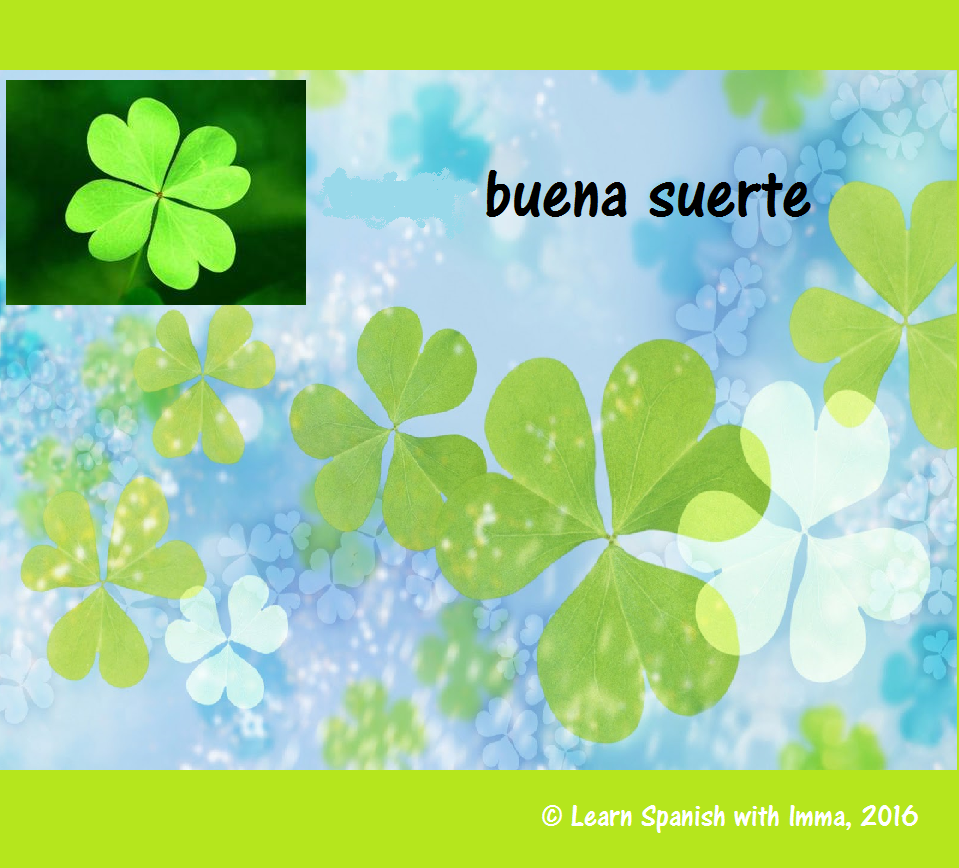
VOCABULARIO: BUENA SUERTE (good luck)


ENCONTRAR UN TRÉBOL DE 4 HOJAS ES SEÑAL BUENA SUERTE. Esta superstición es antiquísima, se cita ya en la Biblia. La buena suerte puede deberse, tal vez, a que  posibilidad de encontrar uno es remota. Hay un trébol de 4 hojas por cada 10 000 de tres.

FINDING A FOUR LEAF CLOVER OR A SHAMROCK IS A SIGN OF GOOD LUCK AND GOOD FORTUNE. This superstition is very old, there is one mention of the 4 leaf clover in the Bible. The chance of finding one, however, is remote as there is one 4 leaf clover for every 10 000 clover, may be that explain why finding one means 'to have good luck'.

HOW WE WISH GOOD LUCK:

¡buena suerte!
¡mucha suerte!
¡suerte!
¡que tengas suerte!
¡te deseo suerte!


In other European languages:

FRENCH: bonne chance; CATALAN: bona sort, molta sort; ITALIAN: buona fortuna; PORTUGUESE: boa sorte; GERMAN: viel Glück; ENGLISH: good luck and SPANISH: buena suerte, mucha suerte.


Saturday, October 8, 2016

Thursday, September 22, 2016

Vocabulario: Una mariposa (a butterfly)


LA BELLEZA DE LA MARIPOSA  - The beauty of the butterfly

In other European languages:

FRENCH: le papillon; CATALAN: la papallona; ITALIAN: la farfalla; PORTUGUESE: a borboleta; GERMAN: der Schmetterlingsstil ; ENGLISH: the butterfly and SPANISH: la mariposa


Sunday, July 3, 2016

SPANISH IDIOMS: Freir espárragos


When we are angry with someone we can use this expression that clearly convey the message of 'leave me alone' or 'you made me angry, get lost.

See below the picture for more examples of how to use this expression but be careful in using it unless your Spanish is almost as good as a native speaker.


Tuesday, June 21, 2016

QUOTES FROM DON QUIXOTE Chap. 18 / CITAS DE DON QUIJOTE Cap 18

(The Cervantes Year 1616 - 2016)

Are there teachings in Don Quijote de la Mancha? Is it a didactic novel? The Middle Ages were big on that and Cervantes, a Renaissance man, follows this tradition, or doesn't he?


Monday, May 16, 2016

HACER SUPOSICIONES / MAKING ASSUMPTIONS

USE OF THE FUTURE TENSE FOR MAKING ASSUMPTIONS


In English when we don't know a fact we can make an assumption based on our experience using 'may' or 'going to':

If the sky is grey and cloudy we can predict:
  • It may rain or
  • It is going to rain.
  
In Spanish we can use the future tense:

  • Lloverá
  • Va a llover

Here are some more examples:


Friday, May 13, 2016

SPANISH CINEMA - A SPANISH AFFAIR-2 (Ocho Apellidos Catalanes)

SPANISH FILM FESTIVAL IN AUSTRALIA 2016

A Spanish Affair - 2 (Rafa & Amaia, dancing)

Last year I wrote this post  A Spanish Affair (8 apellidos vascos) mostly for my students, so they could understand the film better. I wasn't expecting I would be doing it all over again this year but I am.  ‘A Spanish Affair -2 or (8 Apellidos Catalanes) seems to be getting the same accolades in Spain as A Spanish Affair did in 2014, so this has everyone excited, with the rumours that a part 3 is on the cards for next year, with the addition of another regional idiosyncrasy.

In 'A Spanish Affair-2 Catalonia enters the scene. This should not be taken lightly as the Catalan cause tends to polarise things in Spain, willingly or unwillingly; more on this later, now the story line of the film.


THE PLOT
In A Spanish Affair – 2  (8 Apellidos catalanes)
Amaia (the Basque girl) and Rafa (the Andalusian boy) have broken up.  Rafa returns to the South, to Sevilla, and Amaia moves to Girona, one of the 4 main cities in Catalonia, for a change of scene. There she meets Pau, a Catalan, and they fall in love. When Amaia's father, Koldo, finds out that her daughter intends to marry a Catalan he is not impressed. He travels to Sevilla to let Rafa know about Amaia’s plans, expecting that Rafa will go to Girona to regain Amaia's love and sabotage the wedding to that pretentious, bourgeois, know-all Catalan hipster, Pau.

But things in Catalonia are far from being normal. Catalonia has had one single goal since 1714: to recover its sovereignty that is, to become independent from Spain; having repeatedly 
been denied authorisation to held a referendum about the Independence by the central government , Catalans, in defiance, organise every now and then token 'pro-independence' events. In the film the planned wedding of Amaia and Pau will be celebrated in a hypothetical "Catalan Republic" set up in Pau's grandma's "masía" (a typical Catalan farm).

A SPANISH AFFAIR-2  (eating calçots and wearing bibs)


CULTURAL & SOCIAL STEREOTYPES OF THE CATALANS

Here are some cultural aspects that I think are relevant to this film.

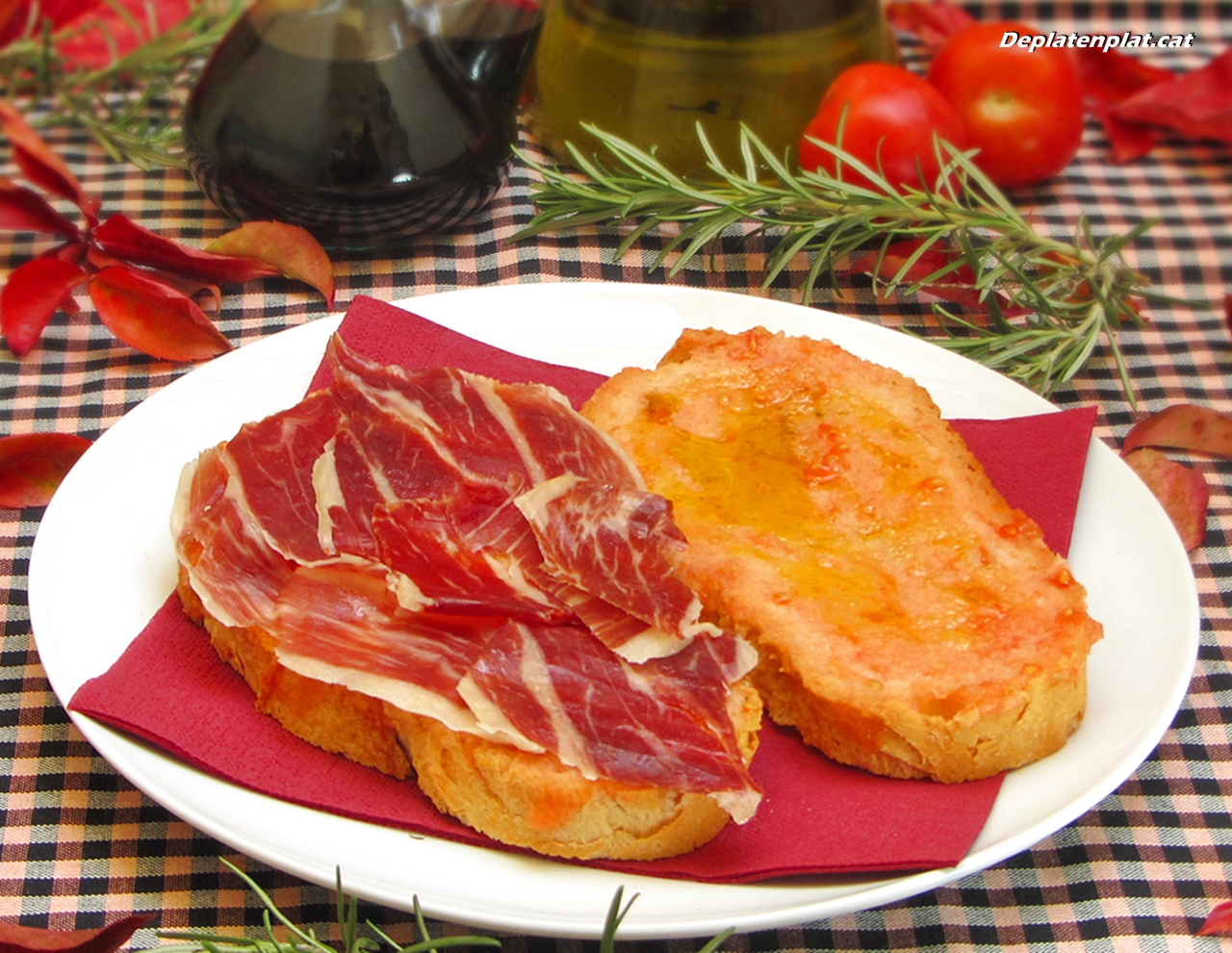
An essential Catalan thing: el pà amb tomàquet. When Catalans have a ripe red tomato in their hands, they cut it in half. They get a slice of bread and rub the tomato on it; they sprinkle olive oil on the bread and add a pinch of salt. It is ready to eat. It only needs an omelette or some slices of salami, jamon serrano, chorizo or cheese added on top. 

Pà amb tomàquet i pernil

 Another culinary Catalan tradition happens every spring in theTarragona area (South of Barcelona) where people go with their family,  friends or colleagues to have a 'calçotada'.  This consists of eating large amounts of "calçots" (fat spring onions) dipped in a thick romesco sauce. The calçots are grilled over a hot fire, wrapped up in newspaper and served on terra cotta tiles.

Calçots a la brasa i salsa romesco

Eating 'calçots' is messy, as there is a lot of charcoal, and the calçots are huge, and the sauce drips everywhere as you raise your arm, with the calçot and attempt to put it into your mouth and eat it as best as you can; restaurants provide their customers with huge bibs to protect their clothes. It is enjoyable and fun and you can eat at your heart's content (=like a pig).

From the same area come 'the Human Towers' (els Castellers) and this also features in the film as part of the wedding celebration.


TARRAGONA - ELS CASTELLERS

So, what do Catalans think of their country? 
Catalans see Catalonia as the center of the Universe, metaphorically speaking as the word of their sea conveys: Med-i-terranean means "the middle of the earth". So they believe they live in a very special part of the Earth. They also believe that they belong to a nation that is civilized, democratic, cultured, open-minded, trendy, entrepreneurial, hard-working, imaginative, innovative, welcoming and, last but not least, truly beautiful. 

Many believe in Utopia and dream of an  independent Catalonia that will be known one day as the 'Norway of the South'. Fat chance, but believing in Utopia is free.

And Catalans? how do Catalans see themselves? 
Many Catalans feel closer to the French than to the rest of Spain. They see themselves as mostly secular and hardworking, a quality  that can be taken to extremes. Many Catalans could be considered workaholics. It is not a coincidence that Catalonia is the wealthiest part of Spain. In general they like to believe that they are an open and welcoming society, they have the reputation of being good negotiators and of taking a business-like approach in many aspect of life, they are pragmatic and practical and they value culture and education. 

Here is the definition of 2 traditional beliefs that Catalans hold dear to:


EL "SENY" Y LA "RAUXA"
I am quoting Wikipedia to explain these 2 concepts:

 "El seny" (from Latin sensus) is a form of ancestral Catalan concept meaning having good judgement, being prudent and acting with common sense. It involves a well-pondered perception of situations, level-headedness, awareness and integrity. Many Catalans consider seny as something unique to their culture, a true Catalan symbol which was passed from parents to children. Notice that I have used the past tense here.   

"La rauxa" is the opposite of seny: it is a sudden determination into action, having a fit of madness, an outburst of passion, some craziness and love of play.

The tricky part of this is how to live your life having these two opposing forces in perfect balance. It is very difficult. Many people believe that Catalans have lost the "rauxa", that they work too hard and don't take the time to enjoy the simple pleasures of life. 

How are Catalans seen by the rest of Spain?

Because Catalans can be so nationalistic & proud these characteristics have been, on occasions, been used against themselves. Some political parties have used the 'Catalan cause' as their scapegoat. People love to have someone to hate, as this makes them forget about their shortcomings and daily frustrations, it is something that happens everywhere. In Australia where I live it was refugees for a while now are the very poor; in the US they believed that they were envied by the whole world and many feared invasions of aliens or who knows who. In any case it is useful, politically speaking, having someone to hate that you consider your inferior or below yourself. In Spain, Catalans have fulfilled this role at different intervals, with different levels of intensity. In all fairness I have to add that Catalan Nationalistic parties have done the same thing against the central government or parties that support the current centripetal status quo. 

I won't go into more detail about this touchy topic, but plenty of information is available in English on the internet.

THE CATALAN LANGUAGE
  
Catalans in the street with Pro-Independence Flags (with the white star)

Catalans have always defended their language with passion, especially during the Franco years, when the attempts to impose Castilian as the national language created a lot of resentment in the bi-lingual parts of Spain, namely Catalonia, Galicia and Euskadi. 

Catalan was not allowed to be taught in schools, so Catalans had to develop strategies to keep their language alive, especially in the written and printed form. Even the poorest of families would buy books written in Catalan, even those who could not or would not read them. It was wrong that Catalans could speak their language but did not know how to write it, as the teaching of Catalan in schools stopped in 1939, with the victory of General Franco. The Basques and the Galicians also defended their national languages, (Euskera and Galician) under Franco, but they were not as successful as the Catalans. 

This is not just a Spanish problem, though. Across the border, in France, the preservation of regional languages did not go well at all. Most have long been dead or mostly dead because the French variety spoken in Versailles crushed them all. Catalans did not allow this to happen with their language and that tells a lot about the kind of people they are. 

I guess that what happens is that minority languages are very fragile and they need the support and the love of their speakers, as they are an important part of their identity; the risk of failing to do that may results in an impersonal world that will end up "using"  8 or 9 languages for communication worldwide. THAT would be very sad. A pandemic of "sameness" is to be avoided at all costs.


What are the negative traits of Catalans? An excess of nationalistic pride that always comes across as too parochial, a tendency for being workaholics and, in general, Catalans are accused of being misers. Their love of money and of being stingy is a characteristic that was also associated with the Jews in the past when they lived in Catalonia in large numbers. Reluctance to spend money and an obsession for saving their money is the subject of many jokes about Catalans. 

As this post is already far too long I will stop here and finish with some jokes about Catalans.

JOKE 1
A man is walking down the street and bumps into a friend. 
The friend says: Any problems in your marriage?

The Catalan replies: No. Why do you ask? 

The friend replies: I notice you are not wearing your wedding ring. 

The man smiles and says: It's because this week it is her turn to wear it.


joke 2
'How do you get 10 Catalans into a car? Throw 2 euros inside. And how would you get them out? Tell them that the car is a taxi.

joke 3
A man visits his Catalan friend. He finds him removing the wallpaper off the walls. 
Redecorating your house? - he asks
No - says the Catalan -  We are moving.

JOKE 4
Three priests (a French, an English and a Catalan) are discussing how they distribute the alms collected in the parish.

The English Priests says they have a fair system. The draw a line on the floor and they throw the money in the air. What falls on the right is for God and what falls on the left is for the parish.

The French priest says their system is similar. They draw a circle. What falls into the circle is for God and what falls outside the circle is for the parish.

The Catalan priest then says: Our systems is the best. We throw the money in the air. What God grabs he can keep and what falls on the ground is for the parish.


joke 5
two flies are talking about holidays.
-Where did you go?
- To the capital. And you?
- Don't want to think about it. I got inside the handbag of a Catalan woman and I spent the whole month locked inside!